Weak Close – Stick — complete breakdown covering formation details, player alignment, routes, and gameplay strategy.
Set it up right and the Weak Close – Stick gives you a clean answer against both man and zone in Madden NFL 27. Here is exactly how to run it at MaddenGuides.com.
Weak Close – Stick — Madden NFL 27 Play Breakdown
A quick-hit Weak Close – Stick reference before we get into the film.
Introduction
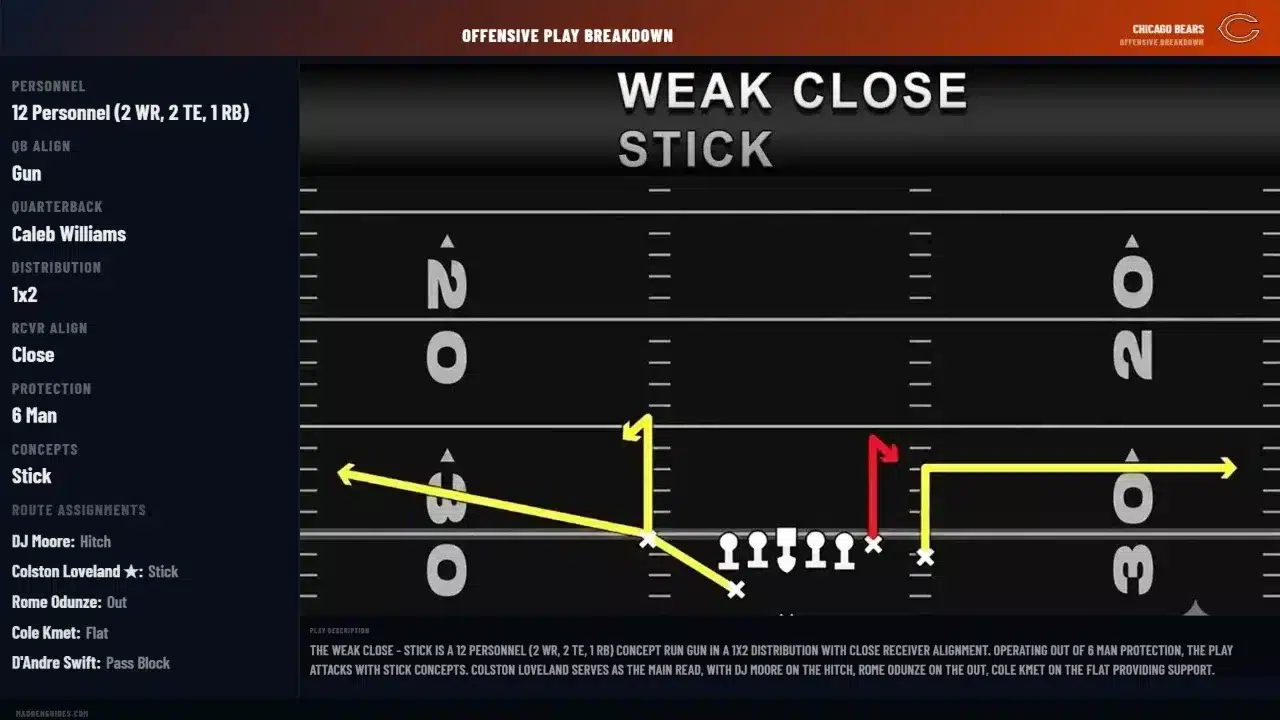
It’s Kobra here, and the Weak Close – Stick is one of my go-to calls when I want a fast, low-risk completion out of 21 Personnel with this Bears roster. Caleb Williams lines up in Gun, works a tight triangle on the closed side, and gets rid of the ball before a rush ever gets home. I like calling it on early downs when I want a stress-free gain that still keeps the offense on schedule for something bigger two plays later.
What makes the Weak Close – Stick concept dangerous is timing, not raw separation. Rome Odunze breaks his out route open first, forcing the flat defender to commit, before Colston Loveland ever settles into his stick and becomes the real target. DJ Moore and Cole Kmet clean up underneath, and D’Andre Swift stays home to protect Williams off the edge.
Weak Close – Stick Play Details

- Play Name: Weak Close – Stick
- Formation: Gun 1×2 Close (21 Personnel)
- Play Type: Pass
- Concept: Stick
- Personnel Group: 21 Personnel (2 WR, 1 TE, 2 RB)
Protection is a 6 Man Empty slide, which is just a line-call, not a backfield personnel change. Set it to Full Slide toward the boundary and Williams gets an extra half-count in a clean pocket, which is usually all this concept needs to finish its read.
Playbooks Found In

- Bears
- Two Back
- Vikings
- West Coast
Four different playbooks carry this look, so if the Bears book is not your style, the West Coast version runs the same triangle with slightly different splits. Check our playbook breakdowns if you want the full route tree for any of these before you commit to one for your franchise scheme.
Receiver Alignment
- Moore (X) Wide Receiver
- Kmet (Y) Tight End
- Swift (RB) Running Back
- Loveland (A) Tight End
- Odunze (B) Wide Receiver
Moore is isolated tight to the left, on the line, with nobody else on that side. The other four bodies stack to the right in the close set, with Loveland tight to the tackle and Odunze flexed just outside him off the line. That 1×2 shape is what tells you Cover 3 Match teams to roll their strong safety toward the trips look, which is exactly the angle this play wants. Pull up our team ratings page if you want to check speed and route-running numbers before you build this into your weekly script.
Default Pass Routes

- Moore (X) Hitch
- Loveland (A) Stick
- Odunze (B) Out
- Kmet (Y) Flat
- Swift (RB) Pass Block
Odunze and Kmet build the flat-to-out combo that stresses the underneath defender first. Loveland works the middle void behind them, Moore gives Williams a boundary escape valve on the backside, and Swift stays in to help the tackle against anything off the edge.
Passing Concept
Stick is a short-area concept built to punish zone coverage by creating a triangle read between a flat route, a stick sitting around five yards, and a deeper out breaking behind it. The flat route pulls the underneath zone defender wide, and the stick settles right into the space he just left. It is a simple read and a quick throw, which is exactly why real NFL offenses have leaned on this shape for decades — you can read more about the strategy roots of triangle concepts like this one if you want the deeper football history behind it.
This particular version out of 21 Personnel gives the triangle an extra layer, since the tight formation puts three of the five routes inside the numbers before the ball is even snapped. That kind of compressed split forces a defense to declare its rotation earlier than it wants to, which is exactly the kind of pre-snap tell Williams should be hunting for on every drop.
Pass Progression Reads
- Read 1: Odunze
- Read 2: Loveland
- Read 3: Moore
- Read 4: Kmet
Loveland is the featured target on this design, but his stick route takes an extra beat to settle, so Odunze’s out actually clears first in real time. Williams should flash to Odunze’s landmark, then click to Loveland the instant the stick sits down, rather than staring down the star matchup and missing the earlier window.
Against Man Coverage
- Loveland’s Stick gives Williams a built-in rub off the formation, which is usually enough separation against a linebacker or slot corner in press man.
- Odunze’s Out is a hard, physical break that wins on timing rather than pure speed, so throw it before the defender can undercut the sideline.
- Moore’s Hitch on the backside is your answer if the defense shows blitz and Williams needs to get the ball out in under two seconds.
- Kmet’s Flat becomes a size mismatch against most slot corners and nickel backs in man coverage.
- Swift’s protection matters most here, since man coverage usually comes paired with pressure off the edge.
How Weak Close – Stick Attacks Cover 3 Match

This is the shell the Weak Close – Stick play was built to beat. Cover 3 Match assigns the flat defender to carry Odunze’s out on the boundary, and once he commits, the middle hook zone is exactly where Loveland’s stick lands.
- Odunze’s Out pulls the flat defender out of the throwing lane before Loveland ever breaks.
- Loveland’s Stick sits in the hole between the curl-flat defender and the hook player, the true soft spot in Cover 3 Match.
- Moore’s Hitch punishes a Cover 3 rolled hard to the trips side, since the backside corner is often playing off.
- Kmet’s Flat gives a second answer if the defense checks into a two-deep shell instead.
Key Strengths
This is not a play built to break the game open, but for what it is designed to do, it does it about as cleanly as anything in the Bears book.
- Fast Trigger: the ball is out inside three seconds most snaps, which limits how much a pass rush can affect the play.
- Built-In Answer to Cover 3 Match: the flat-to-stick combo directly conflicts the underneath defender assigned to that shell.
- Protection Flexibility: the 6 Man Empty slide lets you adjust to whichever edge is getting beat pre-snap.
- Multiple Bailout Routes: Moore’s backside hitch and Kmet’s flat both give Williams a checkdown if the primary window closes.
- Personnel Disguise: 21 Personnel looks run-heavy pre-snap, which can slow a defense’s pass-coverage rotation.
Key Weaknesses
No concept is free, and this one asks you to live with a lower ceiling in exchange for the consistency it gives you underneath.
- Limited Explosive Upside: most completions here settle for four to seven yards rather than a chunk gain.
- Vulnerable to a Sit-and-Rob Backer: a linebacker who reads the stick early can jump the throw to Loveland.
- Odunze Draws the First Attention: a physical corner can reroute his out and delay the whole timing chain.
- Backside Is Thin: Moore is on an island with only a hitch, so a blitz to that side removes a real option.
- Swift Locked into Protection: the checkdown out of the backfield is not available on this exact call.
When to Call the Weak Close Stick
- Early Down Rhythm: use it on first or second down when you just want to stay ahead of the sticks.
- Third and Medium: Loveland’s stick sitting at five yards is a reliable answer against zone drops.
- Two-Minute Situations: the quick timing helps you get in and out of the huddle without burning clock.
- Against Zone-Heavy Defenses: lean on it hard against opponents who play a lot of Cover 3 Match in their franchise scheme.
- Building a Script: pair it with play-action shots off the same 21 Personnel look later in the game — check our franchise strategy content if you want help building that full script out.
Five Tips for Getting the Most Out of Weak Close – Stick
- ID the Mike First: use the A button on the protection wheel before every snap so your slide is set correctly.
- Read the Flat Defender, Not Loveland: your eyes should track Odunze’s man, since his positioning tells you where the stick window opens.
- Full Slide the Pressure Side: if you keep seeing edge pressure from one side, set the protection wheel to slide that way pre-snap.
- Don’t Force Loveland Early: throwing to the stick before it settles is the most common way this play gets picked off.
- Use It to Set Up Play-Action: once the defense respects the quick game, the same look off play-action opens up over the top. Browse more Madden tips and guides for building that follow-up call.
Recommended Player Skills
- Quarterback (Quick Reads): shortens the time it takes to process the Odunze-to-Loveland progression under pressure.
- Slot Tight End (Route Runner): helps Loveland’s stick sit down cleanly instead of drifting off his landmark.
- Outside Receiver (Route Runner): a sharper out route from Odunze creates a longer-lasting conflict on the flat defender.
- In-Line Tight End (Blocking): Kmet’s release off the line is cleaner when he can win his stem against a jam.
- Running Back (Pass Block): Swift needs to hold up in protection since he is not a route option on this design.
FAQ
What coverage does Weak Close – Stick beat best?
Cover 3 Match. The flat-to-stick combo directly conflicts the defender responsible for both zones in that shell.
Who is the primary target on this play?
Loveland is the featured target on the stick route, though Odunze’s out clears first in the actual progression. Williams should still work the play in order rather than staring down Loveland pre-snap, since jumping straight to the star route is the fastest way to miss the earlier window and eat a sack.
What does the Empty protection call actually mean?
It refers to the 6 Man slide protection scheme on the Pass Protection wheel, not an empty backfield. You can still choose Full Slide, Half Slide, Base, or Double Team on top of it.
Which playbooks carry this concept?
Bears, Two Back, Vikings, and West Coast all include this look, though splits vary slightly between books. You can compare route trees against the official Madden NFL 27 playbook data if you want to confirm before locking in a scheme.
Is this a good money play against user defense?
It is solid against a defense sitting in zone, but a smart user linebacker who reads the stick can jump the throw, so mix in the play-action shot off the same look, the way NFL play-callers rotate concepts off identical formations according to NFL.com. Changing your tempo and shot frequency off this exact personnel grouping is what keeps a defense honest across a full four-quarter game rather than a single series.
Final Thoughts

MaddenGuides.com has been breaking plays down like this since 2001, and this kind of read-progression detail is exactly why I still write these the same way I did back when I was an official EA Sports Madden strategy guide author. The goal has never changed: teach the actual football logic under the play, not just a button-press exploit that dies the second EA patches something.
Give the Weak Close – Stick a run in your next franchise game and watch how quickly zone defenses start cheating toward Odunze’s side, opening up everything else in your script. For more film like this, keep digging through MaddenGuides.com, where every breakdown is built the same way — real reads, real coverage logic, real football underneath the Madden name.
External resources: ESPN | Madden NFL 27 | NFL | Wikipedia